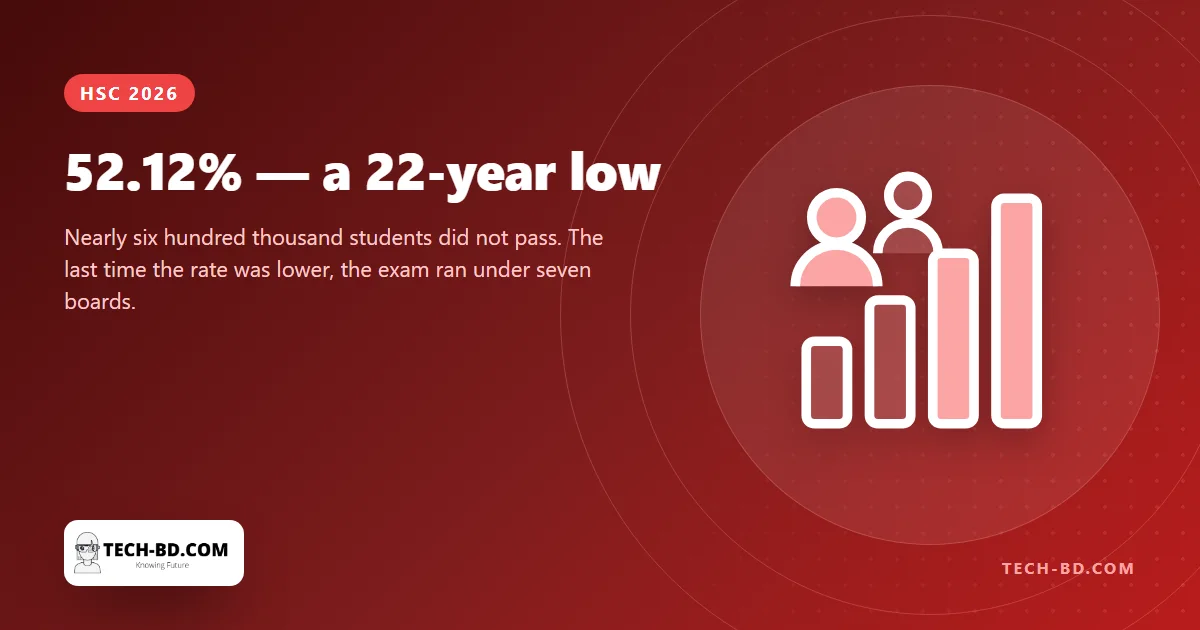
The results of this year’s Higher Secondary Certificate and equivalent examinations were published at 11am on Saturday, 31 October, and the average pass rate across the country’s 11 education boards is 52.12%.
That is the lowest figure in 22 years. Last year the rate was 58.83%, so it has fallen by 6.71 percentage points in twelve months.
The numbers
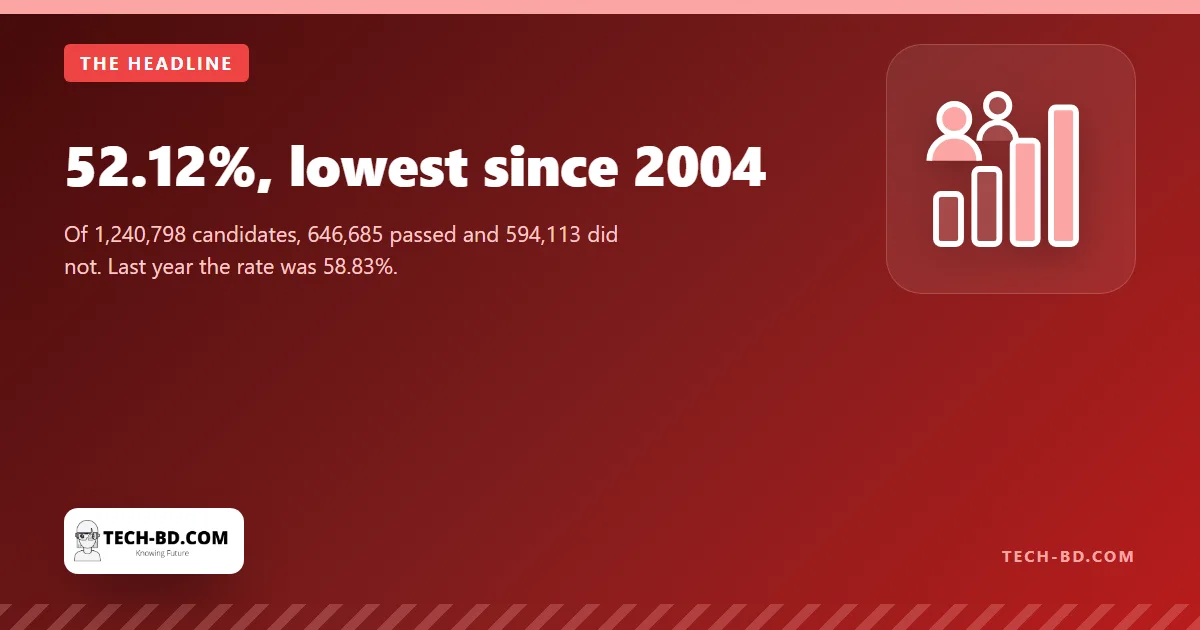
A total of 1,240,798 candidates sat the examinations. Of them 646,685 passed and 594,113 did not. The highest grade, GPA-5, went to 40,084 students.
Taking the nine general education boards on their own, the HSC pass rate is 51.62%, with 541,249 students passing and 35,948 securing GPA-5. Education Minister A N M Ehsanul Hoque Milon inaugurated the publication at the Ministry of Education in the Secretariat; results appeared simultaneously online and at institutions. The date had originally been set for 29 October and was moved to Saturday.
Where this sits in the record
The only lower pass rate on record is 2004, when 47.74% passed and 3,036 students achieved GPA-5 — but that year the examination was held under seven general boards rather than today’s eleven, so the two figures describe different populations.
The series after that climbed steadily: about 59% in 2005, 65.65% in 2006, 64.27% in 2007. Between 2008 and 2018 it fluctuated, peaking at 76.5% in 2012. It fell to 64.55% in 2018 — a twelve-year low at the time — then recovered to 73.93% in 2019. No HSC examination was held in 2020 because of the pandemic.
Reading a pass rate honestly
One caution worth carrying into every story published today. A pass rate is not a direct measurement of how much students know; it is the product of what was taught, what was examined and how the scripts were marked, and a change in any of the three moves the number.
A fall of this size usually reflects a change in marking or examination policy as much as a change in learning, and the boards have not published an explanation. Until they do, the honest description is that fewer students cleared the bar this year — not that this cohort knows 6.71% less than the last one.
What the figure does establish is scale. Nearly six hundred thousand young people are now deciding what to do next, and a large share of them failed in only one or two subjects. That is the part with consequences, and it is covered separately.
The three figures to keep separate
Coverage today will mix three different numbers, and they describe different things.
52.12% is the pass rate across all 11 boards, including the madrasah and technical boards. 51.62% is the HSC alone, across the nine general education boards. And individual board figures — Cumilla at 48.04%, Chattogram at 52.07% — are narrower still.
A headline quoting one and a comparison quoting another will produce a difference that is not real. When reading any claim about this result, check which population the number covers before accepting what it is said to prove.
What has not been published
Three things would make this result interpretable and none of them is out yet: the distribution of marks rather than the count of grades, any statement of what changed in the examination or marking policy, and the size of the institutions recording a zero pass rate.
Until those appear, every explanation offered today — including the ones in this piece — is inference from the shape of the figures.