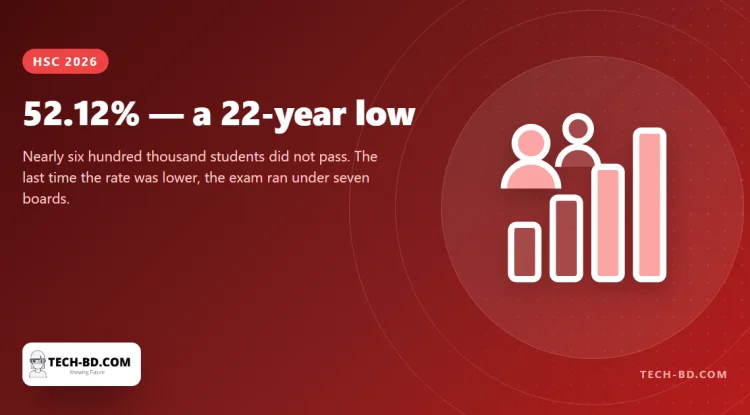
An analysis of the results published by the 11 education boards shows that two subjects account for 382,021 of this year’s HSC failures: 243,528 students failed English and 138,493 failed Information and Communication Technology.
Set against the 594,113 candidates who did not pass overall, those two papers are not one factor among many. They are most of the story.
Why ICT is the one to look at
English failing large numbers is a long-standing and well-documented problem. ICT is newer, and it is the one that should concern a technology publication, because it is a compulsory subject with a practical component in a school system that largely cannot deliver it.
The paper asks students about number systems and conversions, digital logic gates, HTML, database concepts and elementary C programming. Teaching that requires a functioning computer laboratory, a teacher who has written code, and electricity reliable enough for a double period. A very large number of colleges — particularly outside the divisional cities — have none of the three.
What happens instead is that ICT is taught as a memorisation subject: students learn the shape of an HTML tag and the truth table of an AND gate as text to be reproduced, without ever opening an editor or a browser. That works for some questions and fails badly on anything that requires having actually done it.
The pattern inside the geography
This also helps explain figures that otherwise look mysterious. In the Chattogram board, the pass rate in the science stream was 74.42%, against 38.31% in humanities. Science students are concentrated in better-equipped institutions and arrive with more exposure to the material; humanities students in rural colleges sit the same compulsory ICT paper with none of that.
A compulsory subject distributes the cost of weak infrastructure onto the students who had the least of it, and then records the result as their failure.
What would actually move the number
Three things, none of which is a change to the syllabus.
Teachers who have used the tools. An ICT teacher who has never written a line of HTML cannot teach the practical component, and in many colleges the subject is handed to whoever has a spare period.
Working machines, not donated ones. A laboratory of twenty computers, of which four boot, is a laboratory on paper. Maintenance budgets, not procurement announcements, are what keep a lab alive past its second year.
An examination that matches what can be taught. If the paper tests practical competence, the practical component has to exist everywhere the paper is sat. Otherwise the gap between the two shows up every year in exactly this figure.
The uncomfortable implication
ICT was made compulsory to raise digital literacy. On these figures it is instead functioning as a filter that removes 138,493 students from higher education in a single year — and it removes them disproportionately from the places with the least equipment.
That is close to the opposite of the policy’s intent. A subject meant to widen access to the digital economy is, in its present form, narrowing access to university for the students furthest from it.
None of that is an argument for dropping the subject. It is an argument that a compulsory practical paper creates an obligation to supply the practical means everywhere it is examined, and that obligation has not been met.