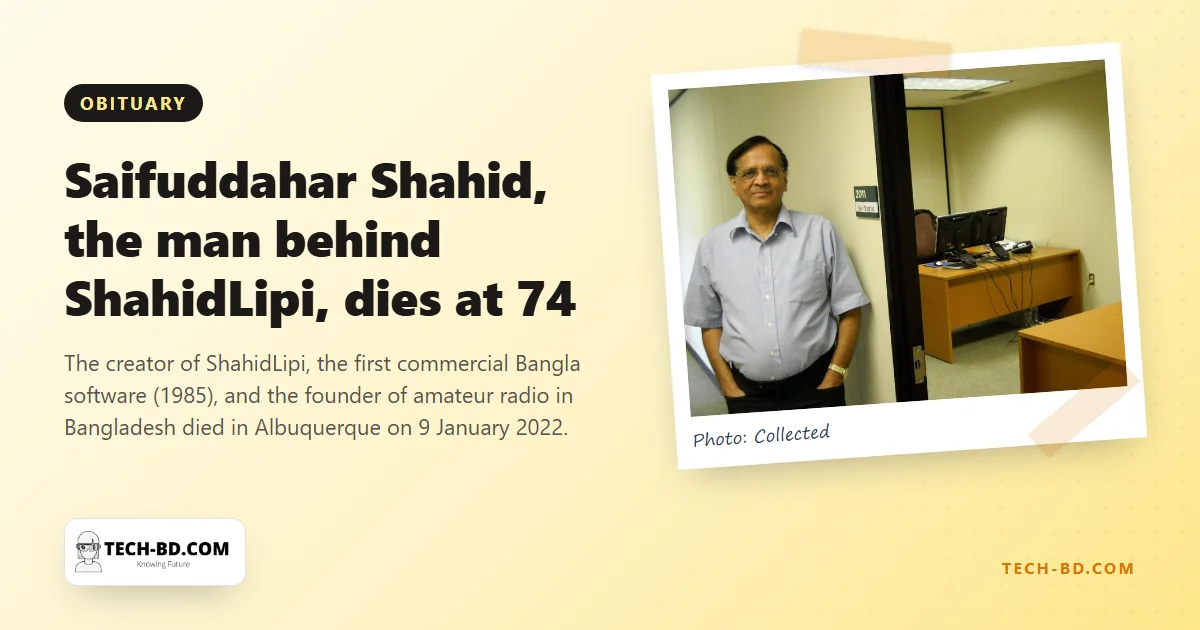
Saifuddahar Shahid, the engineer who wrote the first commercial software for typing Bangla on a computer, died on Sunday, 9 January 2022, in Albuquerque, New Mexico. He was 74 and had lived with Alzheimer's disease for several years. Physicist Munim Hossain, a friend in the United States, confirmed the news to Prothom Alo.
ShahidLipi, 1985
Working alone in London in the early days of personal computing, Shahid programmed a way to write Bangla on the Apple Macintosh and released it in 1985 as ShahidLipi. The first fonts were bitmaps, good enough for the screen but not for printing. He then built laser-printer fonts, and with those the fortnightly Tarokalok and the daily Azad, among others, were typeset in ShahidLipi. He also translated the Mac's menus and dialogs into Bangla, so a user in Dhaka could see the operating system in their own script years before that became normal.
ShahidLipi was sold through National Computers, the company he founded in Dhaka after serving as managing director of Beximco Computers. When he emigrated to the United States in the early 1990s, development stopped, and Bijoy and later Avro took over the market. Bijoy's creator, telecommunications minister Mustafa Jabbar, called him "the pathfinder of Bangla on the computer" on Monday: "as long as Bangla is used in technology, Saifuddahar Shahid will be remembered."
Radio, and an industry association
A mechanical engineering graduate of BUET and a cadet of Faujdarhat Cadet College, Shahid had a second passion. On 20 May 1979 he founded the Bangladesh Amateur Radio League, which under his leadership joined the International Amateur Radio Union in 1982. When amateur radio was finally legalised in Bangladesh on 29 April 1991, he held the country's first licence, call sign S21A. He was also a founding vice-president of the Bangladesh Computer Samity, the industry's oldest trade body, which issued a condolence message.
Why it matters
Every Bangla keyboard layout, every Unicode font and every Bangla interface on a phone stands on the problem Shahid solved first: making a script with conjuncts and vowel signs behave on a machine built for the Latin alphabet. He leaves his wife, a son and a daughter. His funeral prayer was held at the Islamic Center of New Mexico in Albuquerque.
The line that runs from ShahidLipi to your phone
ShahidLipi did not stay alone for long, and the succession explains why Bangla computing looks the way it does now. Bijoy, released by Mostafa Jabbar in 1988, became the layout most professional typists in Bangladesh learned, and for two decades it was effectively the standard in newspapers and government offices. In 2003 a Dhaka medical student, Mehdi Hasan Khan, released Avro as free software with a phonetic layout that let people type Bangla by spelling it in English letters — which is how most people under forty type Bangla today.
Underneath all of them sits the shift to Unicode. Early Bangla software each used its own character encoding, so text written in one program arrived as nonsense in another. Unicode ended that, and it is the reason a Bangla message now survives the trip from a phone to a website to a printer without being re-keyed. Shahid wrote the first step of a chain that took thirty years to finish.