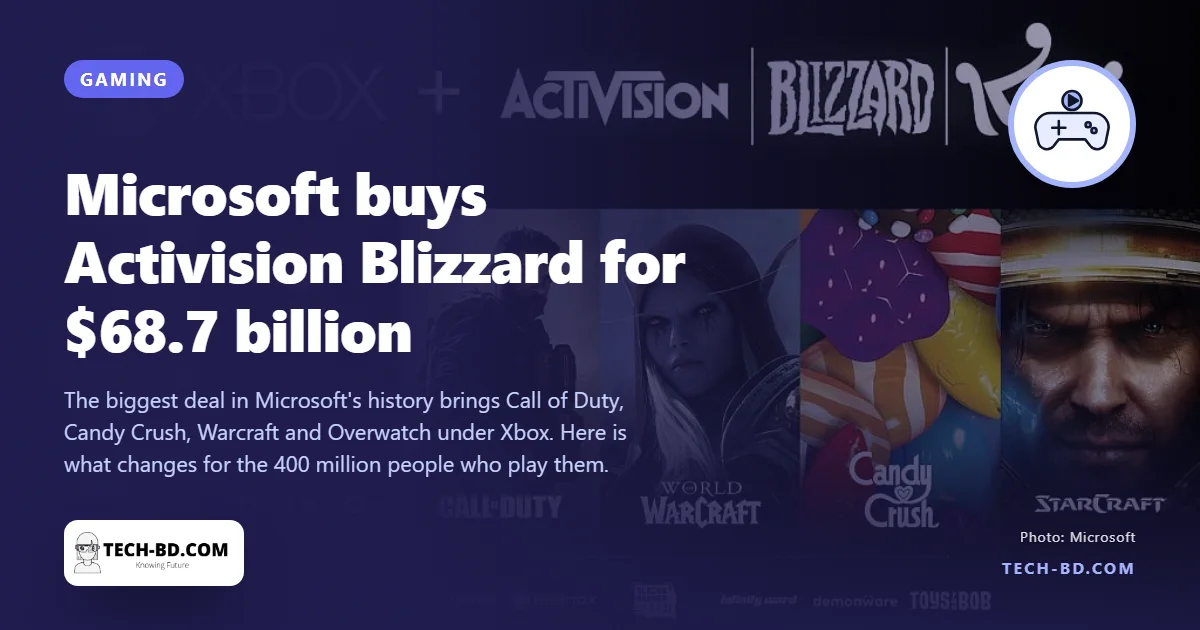
Microsoft announced on 18 January 2022 that it will buy Activision Blizzard, the publisher behind Call of Duty, Candy Crush, World of Warcraft, Overwatch and Diablo, for $68.7 billion in cash. At $95 a share it is the largest acquisition in Microsoft's 46-year history, and the largest ever in gaming, more than three times what it paid for LinkedIn.
The deal in numbers
Activision Blizzard's games are played by roughly 400 million people a month. Once the deal closes, Microsoft expects to become the third-largest gaming company in the world by revenue, behind only Tencent and Sony. Activision chief executive Bobby Kotick, under pressure over the company's workplace-harassment scandal, will stay on for now and report to Phil Spencer, head of Microsoft Gaming. Microsoft's chief executive Satya Nadella framed the purchase as a bet on the "metaverse", arguing that gaming is "the most dynamic and exciting category in entertainment across all platforms".
What changes for players
- Game Pass gets the big names. Microsoft said it will bring "as many Activision Blizzard games as we can" to Xbox Game Pass, its Netflix-style subscription that already has 25 million members.
- Call of Duty stays on PlayStation, for now. Existing contracts run for years; the regulatory fight over exclusivity is where the deal will be decided.
- Mobile is the real prize. King's Candy Crush and Call of Duty Mobile are where the monthly users are. Microsoft has no mobile platform of its own; this buys it one.
The Bangladesh angle
Bangladesh is a mobile-first gaming market. Call of Duty Mobile competes with PUBG Mobile and Free Fire in every university hall, and Candy Crush remains the most-installed casual game on cheap Android phones. Nothing changes on those phones this year, but the long game is clear: a Microsoft account, Game Pass and cloud streaming eventually bundled into the mobile titles people here already play.
What happened next: 21 months of regulators
The deal did not close for nearly two years, and the fight was almost entirely about cloud gaming rather than consoles. The US Federal Trade Commission sued to block it in December 2022. Britain’s Competition and Markets Authority went further and blocked the deal outright in April 2023 — not over Call of Duty on PlayStation, but over the risk that Microsoft would dominate the much smaller market for streaming games over the internet.
Microsoft’s answer was to give that market away. It restructured the purchase so that cloud-streaming rights to Activision Blizzard games outside the European Economic Area went to Ubisoft for fifteen years. The CMA accepted the revised deal and the acquisition closed on 13 October 2023.
What followed was less triumphant than the announcement. Microsoft raised Game Pass prices in 2023, and in January 2024 cut about 1,900 jobs across its gaming division, including at Activision Blizzard. Call of Duty did arrive on Game Pass on release day, as promised, with Black Ops 6 in October 2024.
Update: after a 21-month review, the acquisition closed on 13 October 2023 once the UK's Competition and Markets Authority approved a restructured deal that hands cloud-streaming rights for Activision titles to Ubisoft.