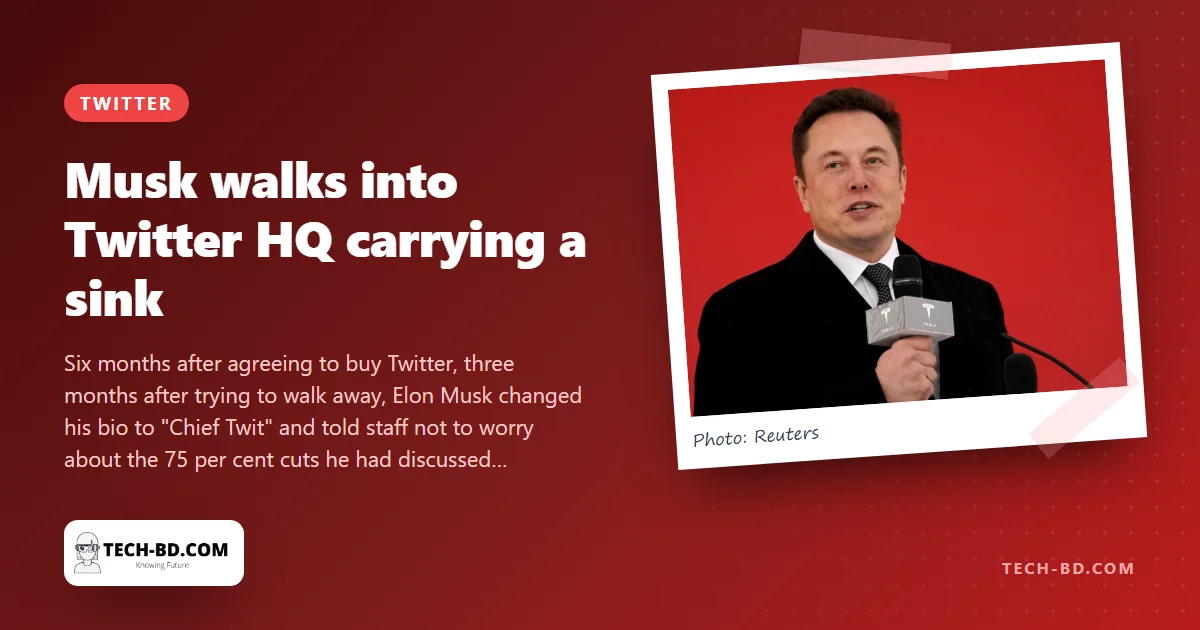
Elon Musk walked into Twitter's San Francisco headquarters on Wednesday, 26 October 2022, carrying a white porcelain sink, filmed it, and posted the clip with the caption "Entering Twitter HQ – let that sink in!" He changed his Twitter bio to "Chief Twit" and his location to "Twitter HQ". Two days before a Delaware court's deadline to complete the $44 billion purchase he had agreed in April and spent the summer trying to escape, the world's richest man was making it clear he had arrived.
How it got to a court deadline
- 25 April: Twitter's board accepts Musk's $54.20-a-share offer.
- 13 May: Musk declares the deal "on hold" over the number of spam and bot accounts, which Twitter puts below five per cent and he claims is far higher.
- 8 July: He formally terminates the agreement. Twitter sues four days later in the Delaware Court of Chancery to force him to complete it.
- 4 October: With a trial two weeks away and his private messages about to be aired in court, Musk offers to close on the original terms. The judge pauses the case and sets 28 October as the deadline.
What he told investors
The Washington Post reported that Musk had told prospective co-investors he intended to cut about 75 per cent of Twitter's 7,500 staff. Twitter's own management, the paper said, had separately planned to cut $800 million from payroll by the end of 2023, roughly a quarter of the workforce. Whoever owned the company, layoffs were coming; on his tour of the office on Wednesday, Musk reportedly told employees the 75 per cent figure was not the plan.
What it means for Twitter's users here
Twitter is a small platform in Bangladesh next to Facebook, but a disproportionately influential one: journalists, diplomats, economists and the country's arguments with the outside world live there. Musk's stated plans, looser moderation, a paid verification tier, fewer staff to handle government requests and abuse reports, will land here as elsewhere, and the first test will be how the platform handles coordinated harassment when the trust-and-safety team is a fraction of its former size.
The $8 tick, and the fortnight it broke
The paid verification scheme launched within weeks and produced one of the fastest demonstrations on record of why identity verification matters. Because the blue tick could now be bought rather than earned, anyone could buy one and pose as anyone.
Within days a verified account calling itself the pharmaceutical company Eli Lilly posted that insulin would now be free. The post was fake, it spread widely before it was removed, and the real company’s share price fell sharply — a reported multi-billion-dollar swing caused by one $8 subscription. Fake verified accounts for Nintendo, Lockheed Martin and several banks followed. Twitter suspended the scheme, then relaunched it with additional checks.
The episode is the clearest case study available of a principle that applies well beyond Twitter: a trust marker that can be purchased stops being a trust marker, and the damage lands on the parties being impersonated rather than on the platform selling it.
Update: the acquisition closed on the evening of 27 October. Musk's first act was to fire chief executive Parag Agrawal, finance chief Ned Segal and legal head Vijaya Gadde. On 4 November Twitter laid off about half its staff, and later that month an $8 monthly fee for the blue verification tick was launched, withdrawn after a wave of impersonation, and relaunched.